
The Overland Problem
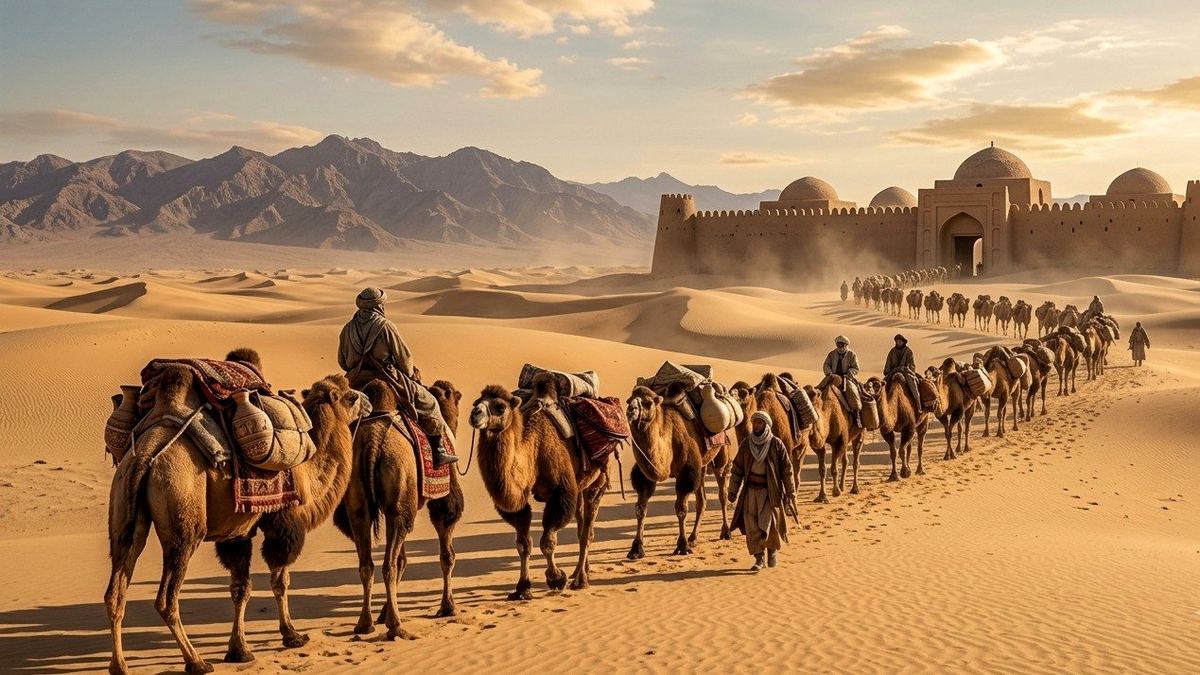
The sea voyage ended in weeks. The caravan trade stretched across years and a continent — and forced the invention of instruments that could carry value where no ship and no coin could safely go.
The bottomry loan of the last essay had a natural boundary: the voyage. A ship left Piraeus, reached the Bosphorus, and returned, and within a season the loan had either been repaid or extinguished with the hull. Risk that resolves itself in weeks is a manageable thing. But not all trade is maritime, and the goods that commanded the highest prices in the ancient and medieval world — silk, spices, precious metals, fine textiles — often moved not by sea but overland, across thousands of miles and many months, through territories controlled by no single law and patrolled by no single power. This is the overland problem, and solving it required a different and more durable set of tools.
Reputation as the first collateral
Consider the Sogdians. An Iranian-speaking people centred on Samarkand, they dominated the commerce of the Silk Road from roughly the fourth to the eighth century — not through military power, of which they had little, but through a network of merchant colonies strung across Central Asia and into China, bound together by kinship, language, and a shared commercial reputation. Their "Ancient Letters," a cache recovered near Dunhuang and dated to around 313 CE, reveal businesses that kept formal accounts, extended credit on agreed terms, and communicated across distances that took months to traverse.
What secured a Sogdian's credit when he stood at the far end of a caravan route, beyond the reach of any court that could enforce a Samarkand contract? Not a pledged cargo — the cargo was moving. Not a legal system — there was none in common. The answer was reputation, enforced by the only sanction that mattered: exclusion from the network. A merchant who defaulted, who cheated a partner, who failed to honour a draft, lost access to the colonies, the credit, and the information that made the trade possible at all. The network was the collateral. This sounds primitive until one remembers that the same mechanism — the reputational discipline of a closed community of merchants — underwrites a great deal of modern trade finance, where a trader's standing in a tight market is worth more than any single document.
The Islamic Golden Age and the instruments of distance
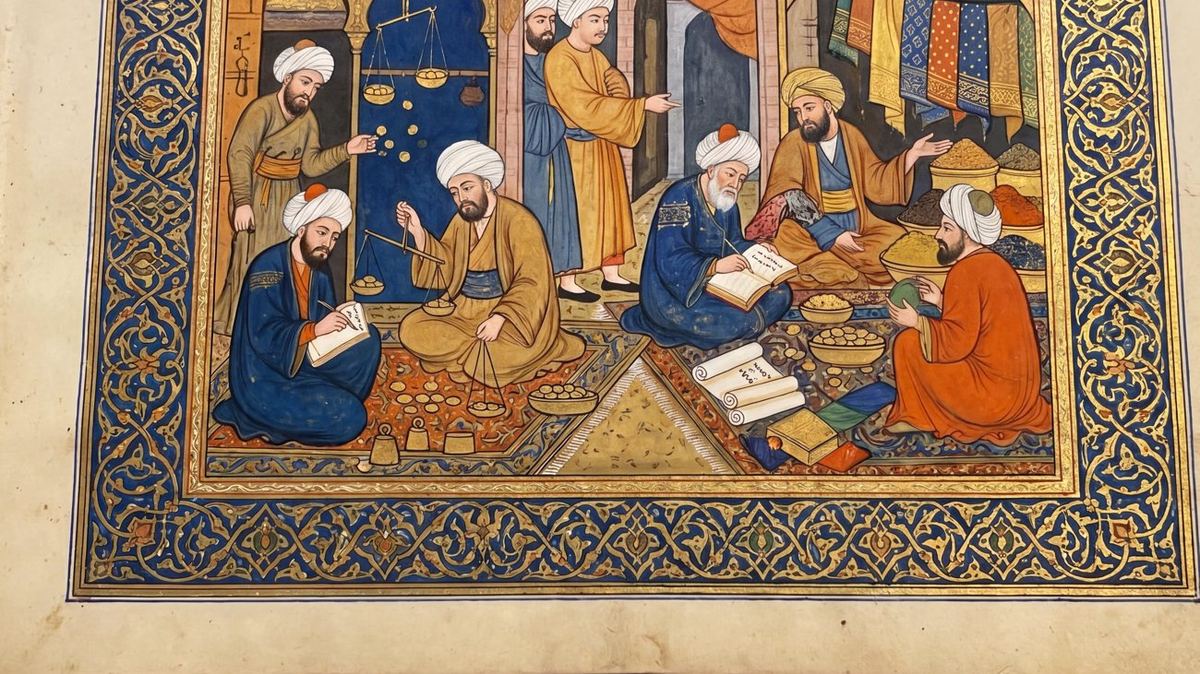
It was the Islamic world, straddling the great routes between the Mediterranean, the Indian Ocean, and Central Asia, that systematised the financing of long-distance trade into instruments — and several of those instruments are the direct ancestors of tools still in daily use.
The first problem was moving value without moving coin. Transporting silver or gold across a continent of bandits and tariffs was both dangerous and expensive, and the answer was the suftaja — an instrument by which a merchant deposited funds with a banker or trusted agent in one city and received a written order making those funds payable in another, often hundreds of miles away. The value travelled as paper and ink; the coin stayed put. Alongside it ran the sakk — a written order to pay drawn on funds held by a money-changer — from which, by way of the Italian cheque, the English word descends. And the hawala, still in use today, moved value through chains of trusted brokers who settled accounts among themselves rather than shipping cash. Each of these solved the overland problem the same way: by substituting a network of trust and a piece of paper for the physical movement of money.
The second problem was structuring the capital itself. A sedentary merchant with money but no wish to spend a year crossing deserts needed a way to back a travelling trader who had the skill and stamina but no capital. The answer was the mudaraba — a partnership in which one party supplied the capital and the other the labour, sharing the profit by agreed proportion, with losses of capital falling on the investor and the loss of effort on the trader. Its sibling, the musharaka, was a joint venture in which both parties contributed capital and shared profit and loss together. These were not loans charging interest, which Islamic law prohibited; they were genuine risk-sharing partnerships, and that distinction shaped the entire architecture of Islamic commercial finance.
The bridge to Europe
Here the threads of this series begin to cross. The mudaraba has a near-exact European counterpart — the commenda — which would become the engine of Mediterranean trade and the subject of the next essay. The resemblance is precise: passive capital matched with active enterprise, profit shared by formula, capital loss falling on the investor. And the timing is suggestive. The commenda appears in the Italian port cities in exactly the period of their most intense commercial contact with the Islamic world — in the markets of Alexandria, Tunis, and Acre, where Genoese and Venetian and Pisan merchants traded daily with their Muslim counterparts and could hardly have failed to observe how that trade was financed.
Whether Europe inherited these instruments directly, reinvented them under similar pressures, or developed them through convergent evolution is a question historians have not fully settled, and honesty requires that we not overstate the certainty. What is not in doubt is the resemblance, and what is not in doubt is the direction of sophistication: in the centuries when early medieval Europe was a commercial backwater, the merchants of the Islamic world were operating bills of exchange, cheques, partnership structures, and remittance networks of real complexity. The instruments that would later be called the achievements of Italian banking were, in their essential logic, already in motion across the routes that the Sogdians had opened and the caliphates had organised.
The function beneath the instruments
Step back from the names — suftaja, sakk, hawala, mudaraba — and the underlying function is the one we have seen from the beginning. Goods of great value had to move across great distances and long stretches of time. Someone had to bridge the gap between the merchant who had capital and the merchant who had the venture; someone had to carry value across territory where coin could not safely travel; someone had to price and share the risk of a journey measured in years. The overland trade did not change the problem. It stretched it — in distance, in duration, in the number of hands a transaction passed through — and in stretching it, forced the invention of instruments robust enough to survive the strain.
Those instruments were the inheritance Europe received, or rediscovered, as the centre of commercial gravity shifted west toward the Italian city-states. What the Italians did with them — and how a tool for moving money quietly became the foundation of the first international banks, and of the first great banking collapse — is the subject of the next essay.