
The Eastern Parallel
China issued government paper money six centuries before the Bank of England and built draft banks that financed an empire. The history of trade finance has a second mainspring, and it turned in the East.
It is easy, reading the previous three essays, to absorb a quiet assumption: that the real history of finance runs from Mesopotamia through the classical world to Italy and onward to London, with everywhere else a footnote. The assumption is false, and this essay exists to correct it. While Greece was lending on bottomry and Florence was perfecting the bill of exchange, China was independently developing instruments of comparable and sometimes greater sophistication — remittance drafts, government paper currency, and eventually a network of banks that financed the trade of the largest economy on earth. The function was the same as everywhere in this series. The lineage was entirely its own.
Flying cash
The story begins, as it so often does, with the awkwardness of coin. Under the Tang dynasty the Chinese economy outgrew its supply of copper currency, and the highest-value trade — above all in tea, carried from the southern growing regions to the markets of the north — required moving quantities of metal coin too heavy and too vulnerable to transport safely over such distances. The merchants' solution, devised in the early ninth century, was feiqian — "flying cash."
A tea merchant who had sold his goods in the capital could deposit the proceeds with the liaison office that his home province maintained there, receiving in exchange a certificate — one half of a document whose matching half travelled separately — redeemable for coin when he returned home. The money "flew" home as paper while the merchant travelled light. The state, initially suspicious of a private instrument that looked like a usurpation of its monetary authority, came to see its usefulness and formally took the system under official supervision in 812. What the Tang merchants had built was, in everything but name, a bill of exchange — a remittance instrument settling value across distance through matched records — and they had built it four centuries before the fairs of Champagne.
The world's first paper money
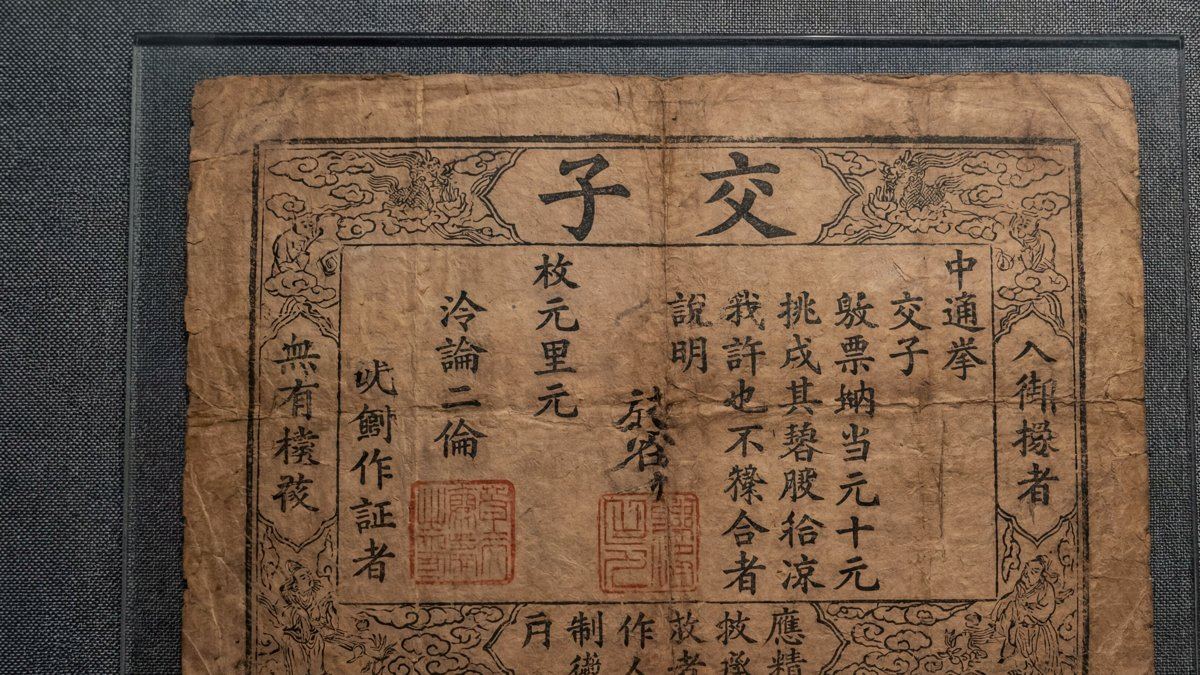
The next step was taken in Sichuan, a province ringed by mountains and burdened with an especially cumbersome iron coinage that made large transactions a physical ordeal. Late in the tenth century, merchants there began issuing private paper notes — jiaozi — against deposits of coin and goods. The notes were promises to pay, redeemable for metal, and because they were far easier to carry than iron cash they began to circulate as money in their own right. The most substantial merchant houses, sixteen of them, standardised the notes and stood behind them, underwritten by the trust of Sichuan's tea-trading community.
Private issue, however, carried private risk: when issuers failed, their notes failed with them, and confidence wavered. The state's response was decisive and historic. In 1023 the Song government established a paper-notes office at Chengdu and took the issuance of jiaozi into its own hands, creating the world's first government-issued paper currency — more than six and a half centuries before the Bank of England printed its first note. Later issues followed, and later still the Southern Song huizi circulated across much of the empire. The system eventually fell to the temptation that has destroyed every unbacked paper currency since — over-issue, and the inflation that follows — but the achievement stands. The mechanism the modern world regards as the foundation of its monetary system was operating in China while medieval Europe still counted entirely in coin.
The draft banks of Shanxi
The richest chapter in this parallel history is the most recent, and the most directly a story of trade finance. In the early nineteenth century, in the landlocked province of Shanxi, a remarkable institution emerged: the piaohao, or draft bank. Its founders were the Shanxi merchants who had long run the overland tea-and-fur trade north to Mongolia and Russia along the routes that descend directly from the Silk Road — the same Inner Asian corridors the Sogdians had worked a thousand years before.
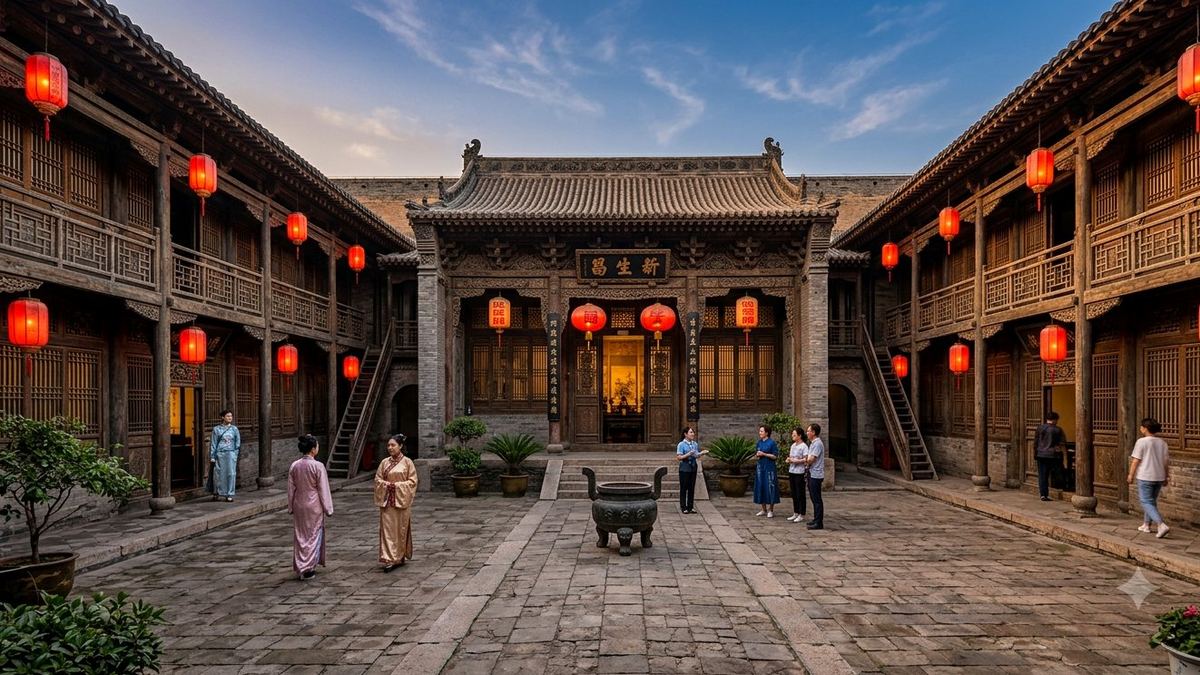
The first piaohao, Rishengchang — "Sunrise Prosperity" — was converted around 1823 in the town of Pingyao from a dye business, when its manager, struck by the cost and danger of physically shipping silver between the firm's branches, proposed instead a clearing house for remittance. The model was simple and powerful. For a fee of roughly three-tenths of one per cent — against the two or three per cent it cost to move silver under armed guard — a merchant could deposit funds at one piaohao branch and draw them at another, anywhere the network reached, with the drafts authenticated by rotating cipher codes and matched tallies to defeat forgery. It was the suftaja and the bill of exchange, arrived at independently, and operated at imperial scale.
The model spread fast. By the end of the nineteenth century several dozen piaohao operated some five hundred branches reaching into every province of the empire and out to its frontiers, with the towns of central Shanxi — Pingyao, Qixian, Taigu — functioning as the financial capital of China. The piaohao financed the great interregional trades in tea, silk, and salt, letting a merchant buy upcountry and settle downstream without ever shipping metal. At the Hankou tea hub, where none had operated before the port opened to foreign trade, twenty-two piaohao had established themselves by 1881 to finance the Chinese middlemen buying tea for Russian merchants. And from the upheavals of the mid-century rebellions onward, the piaohao increasingly took on the business of the state itself — remitting tax revenue to the capital, advancing funds to provincial governments, running regional treasuries. They have, with justice, been called China's first state banks.
The native banks and the meeting of two worlds
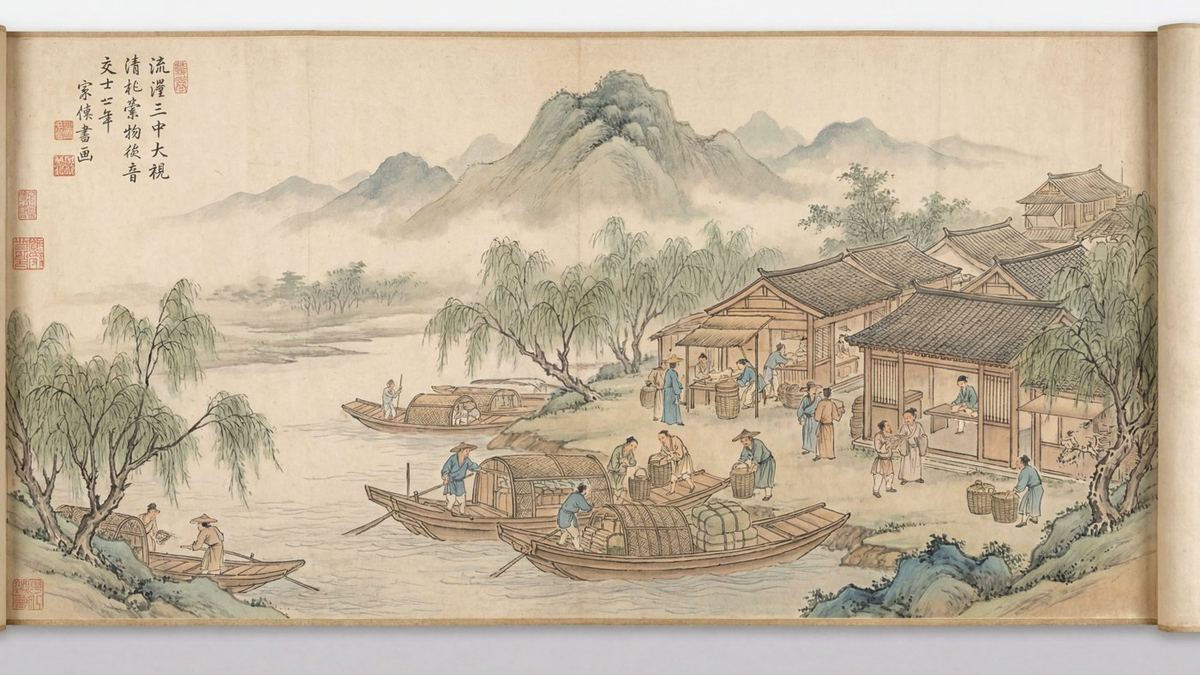
Alongside the remittance-focused piaohao ran a second and more locally rooted institution: the qianzhuang, the native banks or money shops of Shanghai, Ningbo, and the cities of the Yangzi delta. Grown from money-changing businesses, they were commercial banks in the fullest sense — taking deposits, discounting bills, issuing their own banking orders, and financing the daily commerce of the ports. There were perhaps ten thousand of them across China by the early 1890s, most thinly capitalised but heavily leveraged, a single Shanghai house often carrying a million taels of loans against a fraction of that in paid-up capital.
It was the qianzhuang that formed the hinge where the Eastern and Western traditions of this series finally met. When the foreign banks arrived in the treaty ports after the 1860s — the Hongkong and Shanghai Banking Corporation foremost among them, founded in 1865 expressly to finance the China trade — they faced a problem the Sogdians would have recognised: they could not assess or reach the Chinese merchants of the interior. Their solution was the comprador, a Chinese intermediary who guaranteed local credit and bridged the two commercial worlds, and the chop loan, a short-term advance the foreign banks made to the qianzhuang, which in turn financed Chinese merchants trading foreign goods. The chain ran from foreign bank to comprador to native bank to merchant, and through it Western capital entered the Chinese domestic credit system. The bill of exchange and the suftaja, the London acceptance and the piaohao draft, were now operating within a single connected machine.
The end of the indigenous system
Both Chinese institutions fell in the early twentieth century, and the manner of their falling is itself instructive. The piaohao had bound themselves tightly to the imperial state and were organised as unlimited-liability partnerships — structures that magnified both their reach and their fragility. When the dynasty collapsed in the revolution of 1911, the piaohao were devastated by the disorder and stripped of the government business that had sustained them, and they fell almost as one. Rishengchang itself, undone by a bad guarantee, was reorganised and limped on before closing in 1932. The qianzhuang, more commercially supple and less dependent on the state, survived longer, but they too were progressively displaced by modern joint-stock banks and broken by a succession of financial panics.
The torch passed, in China as in Europe, to the institutions of the modern era — the joint-stock banks, the central banks, the documentary instruments standardised across the world. But the function the piaohao and qianzhuang had served did not pass away. It was the same function the temple lenders of Babylon had served, and the Sogdian caravan merchants, and the Florentine bankers: to move value across distance and time, to substitute trusted paper for the dangerous transport of treasure, and to extend credit between parties who could not directly assess one another. China arrived at that function by its own road. That two civilisations, separated by a continent and largely ignorant of one another, built such similar machinery from such similar pressures is the strongest evidence this series can offer that trade finance is not a Western invention or a modern one. It is a permanent feature of organised commerce, wherever and whenever goods must move faster than money safely can.